Tuesday, February 14, 2012

Tell your story!

In the past I've given out a number of "person's choice" awards for digital data use and storytelling. Humanity United won one for their performance report and the Knight Foundation for a slide presentation of evaluation findings. As the person's choice they reflect the wisdom and opinions of, well, me, a single person. And the prize for winning? Well, I name you on this blog. Not exactly bankable.

I'm thrilled to tell you that the good people (as in more than one person) at TechSoup are giving out real awards with actual prizes (iPads, FLIP video cameras, software, Flickr Pro accounts) in their TechSoup Digital Storytelling Challenge (#TSDIGS). So, now is your chance, get out and tell that story.

How to get involved:
Deadline is February 29, 2012.

The challenge is open to all social benefit organizations regardless of 501(c)(3) status or location.

Heck, these folks even have an awards ceremony...As they say where I'm from, "Ya gotta be in it to win it!"


Monday, February 13, 2012

Creating 21st C Governance Models - #Takebackthepink

Yesterday (Sunday) I attended a women's basketball game at Stanford (The Cardinal beat UCLA 82-59). Maples Pavilion, home to Stanford basketball is usually a sea of cardinal red. Yesterday, it was a sea of pink.

Pink Zone Day to support breast cancer awareness - Wear Pink!

In honor of the Stanford Cancer Center, the team's many faithful were wearing pink t-shirts, sweatshirts, even pink baby carriers. The Ogwumike sisters (Stanford star players) both sported pink headbands. Several of the UCLA players work pink sneakers. As soon as my son and I entered the arena we knew three things - basketball, women, and cancer.

That's how powerful a symbol pink has become. The color - in mass quantities - registers on the brain as a symbol of cancer. Not as the symbol of a specific organization, but as a symbol of a disease, those who've succumb to it, and its many survivors and memories.

This was enormously powerful to me because of the events of two weeks prior. Here's a summary of what happened in the week leading up to Super Bowl Sunday. The text below was jointly written by Allison Fine, Beth Kanter, Stephanie Rudat, Amy Sample Ward, Lisa Colton, and me. Similar versions with their own additional commentary can be found  on allisonfine.com and bethkanter.org.

The document below is our attempt to do a rapid reflection on a set of activities. Posting it here and on Allison's blog and elsewhere is our way of sharing what we learned and of inviting you in to the conversation.

From my own perspective, these events indicate an important new expectation of transparency for nonprofits and foundations. Just as Bank of America, Verizon, the legislative sponsors of SOPA and PIPA, and the users of the Path sharing network have discovered, your customers, your supporters, your voters and people moved by a cause are paying attention. They care about the issue and will let you know when they support you and when they disagree with you. This isn't a "maybe," this is the way it is - as the story linked above on SOPA/PIPA calls it, "It's a first draft of the future."

Nonprofits and foundations are used to being held accountable by their boards of directors. That governance structure is our 20th century answer to "how to hold independent, tax exempt organizations accountable to the public." It is not a 21st century solution. This is not simply a matter for crisis communications. It's even more than the free agent/fortress model that Beth and Allison write about in The Networked Nonprofit.

Today's tools and expectations would not lead us to create the kinds of governance models that we built a century ago. It's not enough to think about adapting old models to new tools, although that certainly needs to happen. We are building new models. Just as garage inventors are out there creating new technologies they are also out there creating the organizations, governance, accountability, transparency and privacy models that fit our current capacities.  These are the models that will survive the next 100 years.

-----

Reflections on Take Back the Pink Campaign

"We're not good at thinking fast. We are good at feeling fast." - Clay Shirky


This reflection document is our group effort to capture and think about a flurry of social media activity that we organized last week. It includes a chronology of what happened, when, immediate results of our efforts, and lessons learned. We hope others will add to the document and share their own reflections as well.


The Catalyst: The Susan G. Komen Foundation Will Not Fund Planned Parenthood’s Breast Health Screenings Beyond this Year.


On Tuesday, January 31, 2012, the AP reported that the Susan G. Komen Foundation’s board had decided to stop providing grants to Planned Parenthood affiliates to support breast health efforts. As word began circulating on social media channels like Facebook of Komen’s decision, Planned Parenthood posted, and emailed out to their supporters, a petition created by a supporter.  

Komen’s decision would discontinue financing for nineteen of Planned Parenthood’s eighty-three affiliates, which received nearly $700,000 from the Komen Foundation in 2011 and have been receiving similar grants since at least 2005. As reported by The New York Times here, the decision was political: the board created a policy of not funding organizations under government investigation as a strategy for not funding Planned Parenthood.  


The announcement angered a large number of people who had supported Komen by walking, running and donating for decades. The Komen pink ribbon, which the organization has fiercely and litigiously protected over the years, has dominated the breast cancer research landscape for years and overshadowed many other effective, transparent organizations in the breast cancer arena. The deep and fundamental sense of betrayal on the part of Komen supporters, many of whom are also Planned Parenthood supporters, fed an outpouring of anger and acrimony aimed at Komen by email, on Facebook and Twitter. 


As Kivi Leroux Miller reported on her blog, the outpouring of anger picked up steam as Komen was noticably absent from the social media conversations.


See this blog post re: the reaction
http://www.journalism.org/commentary_backgrounder/On+Twitter+Still+Tough+Going+for+Komen?src=prc-twitter


How did we organize for a collective action in a fluid situation?

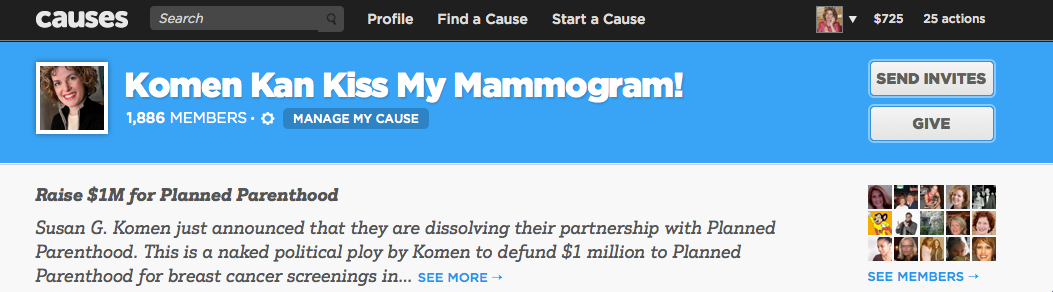
Petitions and expressions of outrage felt good, but didn’t seem like enough tangible action to make it clear to Komen that their action was outrageous. Allison Fine started an open conversation on Facebook to discuss this. Out of that conversation came the idea for an online fundraising effort to support Planned Parenthood using Causes on Facebook called, “Komen Kan Kiss My Mammogram.” She circulated the link by email and on Facebook.


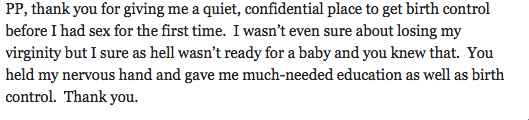
On that same Facebook thread, Deanna Zandt reported creating a Tumblr blog called Planned Parenthood Saved Me. The sites enables people to tell their personal stories of how their lives were improved or saved because of the health screenings services at Planned Parenthood. Here is one story from the blog:


Later that day, Beth Kanter created a Pinterest website with the same name capturing the growing number of images expressing anger and displeasure at Komen and posted on her blog about the anti-Komen activities over the previous 24 hours.


From Beth’s link on her blog to the Causes fundraiser, there were 3,800 click thrus out of 3,800 tweets with the link - pretty amazing.


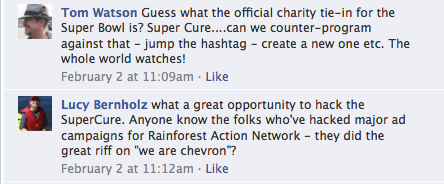
Again, back to the Facebook open, thread, an interesting exchange took place between Tom Watson and Lucy Bernholz:


The conversation shifted to how to catch the attention of some the Super Bowl’s enormous audience. Based on the past few years, the combination of the largest media event of the year, the controversy around Komen, a long-time partner of the NFL, and social media (it was reported afterwards that 11.5 million tweets were sent during the game) would be fertile ground for a protest of some kind. An idea developed to capitalize on the upcoming Super Bowl and the partnership the NFL has with Komen and make a loud statement about the need to take politics out of women’s health issues on Twitter by “jumping” the Komen hashtag. We were aiming to capture just a small sliver  of people paying attention to Komen on Super Sunday, self identified by their use of the Komen hashtag of #supercure, to broaden the conversation about breast cancer and women’s health beyond Komen.  

And a meme was born.

Great idea! Ummm, what’s “jumping a hashtag” mean exactly? We weren’t sure, but we had three days to figure it out! 


We decided that surprise would be a necessary element to the planned Sunday attack. We began an email thread to supercede the Facebook conversation. We invited the participants from Facebook to join the email conversation. 


Amy Sample Ward set up a Google doc that would serve as a landing site to explain the planned jump. We would plan by email in advance of the Super Bowl. The instructions on the Google doc were:


Beth also created a wiki with more information and resources for people interested in joining the Take Back the Pink effort.  


We had built up a full head of steam by Friday when Komen announced it was reversing course and would allow Planned Parenthood affiliates to apply for future grants. Our group unanimously decided to continue our plans for the hashtag jump. 


As a result of Komen’s reversal, though, we had numerous conversations about shifting the focus of our efforts from an anti-Komen message to a more positive message. There are a lot of resources and organizations working to eradicate breath cancer and for breast health. We realized that the group of us cared deeply about the issue and knew there were many organizations doing good work.  We wanted to take a positive tone of support for women’s health efforts and helping people understand there are lots of choices for how to be active. By highlighting a variety of organizations and movements on Facebook, we created a resource for people to keep them engaged on women’s health and ending breast cancer if they felt betrayed or discouraged. 


Over the next twenty-four hours our goals evolved and our email group expanded significantly and eventually splintered. We quickly realized that it was a mistake to try to organize such a large group by email; it’s not a good vehicle for large group conversations. In addition, people added to the email list without their permission felt they were being spammed, not a good route to engagement! A better strategy would have been developing a plan of action with a small group, then reading out to people individually and pointing them to the Google doc with a clear plan and requesting their support and action. If we were going to continue to use email to invite more people to the effort, a better strategy would have been to  invite folks in small batches with an invitation to opt out immediately and get them off the list the minute they ask. 


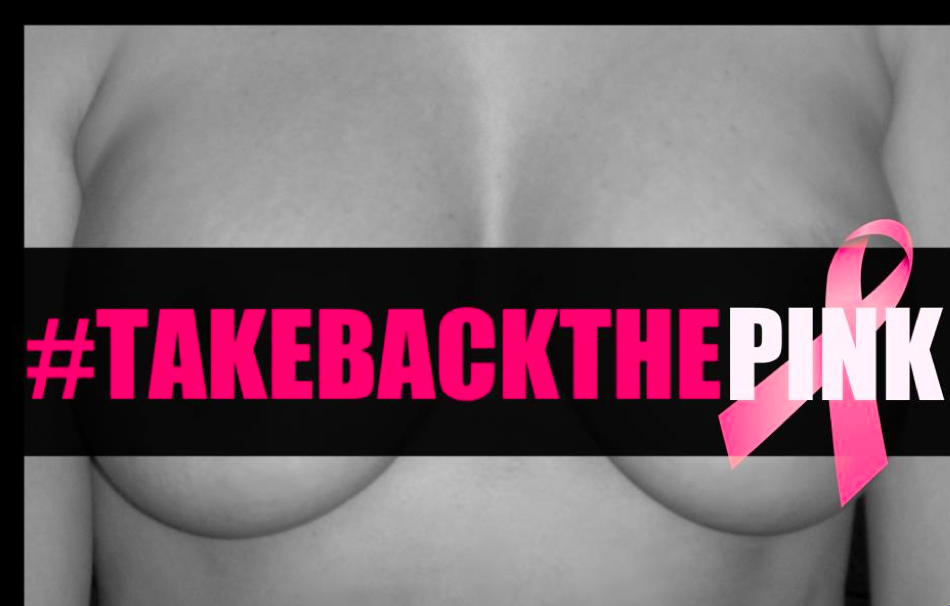
On Saturday night, the group on the email thread decided that an embargo of the effort until Sunday would be counter productive, we needed to get the word out sooner to encourage people to participate on a day they may not ordinarily use for protesting and awareness raising. Saturday night, Stephanie Rudat created a Facebook page with an eye-catching and very sharable logo:


The Facebook page became a central organizing spot for aggregating resources, plus positive infographics on breast cancer in order to drive supporters to a permanent home.   We didn’t have the time to organize a full-scale blogger outreach campaign, although our effort was covered by Blogher.


Late Saturday night, Lucy kicked us off with a simple tweet, “Join us tomorrow to #takebackthepink #supercure.


Immediate Results

By Monday, February 6th, the quantitative results included:

  1. There were 1500 tweets with the hashtag #takebackthepink, with several influencers retweeting it out to their networks (see below)
  2. While the majority of people tweeting the hashtag pointed to positive messaging around breast,  several tweeters retweeted the hashtag pointing to anti-komen posts.
  3. We have a hypothesis that Komen changed its social media plans as a result of the fury aimed at them all week online. We don’t know whether or not that’s true. From our read of the twitter feed, a larger majority of those tweeting #Supercure were also tweeting #takebackthepink.

  1. There were many hashtags and memes created - #takebackthepink was only one. Yahoo! posted this list on which #takebackthepink does not appear http://news.yahoo.com/blogs/signal/twitter-users-drove-furor-over-komen-planned-parenthood-160326208.html (see full graphics and stats below)
Lessons

  1. We could not plan for an event like this, however as individuals who are  unencumbered by organizational rules or policies, and that we have our own large networks of people to bring to an effort, and that we are comfortable working in a dynamic, flat, environment, we reacted very quickly and nimbly to events as they unfolded and provided avenues for action for other people angry at Komen. A core group of the organizers are fluent with a variety of social media platforms including Twitter, Pinterest (a fun opportunity to take it out for a social change spin, thought Beth!) and Facebook, plus Stephanie’s graphic design expertise. As one participant recalls, “There was an immediate sense of relatedness amongst the group conjoined by leaders.  We all saw something in the uproar and possibility for ourselves and those we care about.”
  2. #takebackthepink was a particularly resonant phrase with our group because it represented the opportunity to begin to separate Komen from the color pink. As Lucy would tweet later, “Pink is a color not an org.” A fundamental part of our effort was to reestablish the primacy of women’s health over the branding concerns of a single organization. We believe we created an opportunity for a large number of people to participate in this process, and the momentum to continue the discussion moving forward.
  3. There were two moments of tension during the week between a centralized approach and a network approach. The first time, the effort split in two; with one group focused on fundraising and another on advocacy and awareness. The second, a faction chose to opt out of the Super Bowl effort. Both times it was brought up that it was no longer about recouping money to PP (as that was already achieved in the first 48 hours) but was about redirecting people’s emotional responses, keeping people connected to causes and organizations even if they weren’t Komen, and demonstrating the importance of knowing what the orgs do that you support.
  4. There was a flow of people in and out of the effort depending on their interest and availability. A public thread rather than the private email thread would have been more in keeping with our interest in and value of transparency. We chose the email vehicle believing that the element of surprise would be important to our efforts. It turned out not to be the case.
  5. Finding the messaging middle ground in a fast changing environment was very challenging. Take Back the Pink was seen by some as Komen bashing and by others as “too nice.” We did our best to find a positive place for Super Bowl Sunday: there are a lot of organizations and way to support breast health, here are options in addition to Komen. It was harder to communicate than, “Screw Komen, fund Planned Parenthood” and it’s unclear how successful we were in explaining the shift and making the message clear.
  6. We could have done a better job of looking for other hashtags in real-time and piggy-backed on them in order to weave together different conversations.
  7. We developed and shone a spotlight on nonprofits and transparency, an unusual element to a discussion of pro-choice and women’s health issues.  
  8. Defining success in a very fluid situation was also very challenging. If fifty people retweeted with our hashtag was that success? Five hundred people? Five thousand people? An interesting model to use for comparison is Occupy Wall Street. Rather than using numeric outputs as goals, perhaps our effort, simply being and spreading, was successful. We are still wrestling with this question, although perhaps one answer is that if a single person learned about a new resource or organization that was success. Having the single largest media event of the year on the immediate horizon made for a great leverage point.
  9. It would have been great to have advocacy organizations sign on as participants and partners in this event, however, when we did bump up against organizations they were unable to move fast enough with their approval processes to fully participate. This will continue to hamper the ability of organizations to work with “free agents” like us who need to meet an opportunity like this with speed, agility and a lack of concern for traditional message controls. Perhaps organizations can more fully participate in the next phase of development of the Facebook page.  
  10. This group is open to continuing the Facebook page and the conversation about general breast health and the array of organizations and resources available to women.  Clearly, there is a void in the digital space for being a resource to those who want to learn, contribute, volunteer, receive services but don’t know of all of the options or how to vet. Our capacity is stretched, though, we all participated in this effort as volunteers.


Additional Stories/Resources

BlogHer:
http://www.blogher.com/will-super-bowl-twitter-campaign-help-women-takebackthepink

Working Wikily (and Schusterman Foundation cross post)
http://workingwikily.net/?p=1851
http://www.schusterman.org/blog/clsff/network-lessons-from-the-pink-ribbon-rebellion#more-7109

Yahoo’s list of hashtags
http://news.yahoo.com/blogs/signal/twitter-users-drove-furor-over-komen-planned-parenthood-160326208.htm

The Twitter User Who Drove the Furor Over Komen and Planned Parenthood
http://news.yahoo.com/blogs/signal/twitter-users-drove-furor-over-komen-planned-parenthood-160326208.html

Super Breast Sunday: TakeBackThePINK
http://pinterest.com/kanter/super-breast-sunday-takebackthepink/

#TakeBackthePink - @Komenforthecure’s Social Media Nightmare
http://www.business2community.com/public-relations/takebackthepink-komenforthecures-social-media-nightmare-0129052

Irrevocable Damage: 24 Hours in the Life of a Komen Executive
http://www.buzzbox.com/hillary/MyBuzzBox/2012-02-04/komen:planned-parenthood/?clusterId=8431755&utm_source=twitterfeed&utm_medium=twitter

Lessons from the Pink Ribbon Rebellion
http://ejewishphilanthropy.com/network-lessons-from-the-pink-ribbon-rebellion/

Seven Lessons Learned from Susan G. Komen-Gate
http://www.loop21.com/politics/seven-lessons-learned-susan-g-komen-gate?page=4


Thursday, February 09, 2012

Abundance: The Future is Much Better Than you Think

I jumped at the chance to review Peter Diamindis and Steve Kolter's forthcoming book, Abundance. I'm a believer in the power of shifts created by everpresent data, ever-expanding processing power, creativity, and human connectedness. I read a lot of future oriented stuff - both pro and con - and I knew these authors would have the inside track on a lot of it. I'm a Singularity University wanna-be and a Fellow at a place called the Hybrid Reality Institute. I knew the book would talk about DIY, prizes, and philanthropy because of Diamindis' work with the X Prize. I've heard him speak, read some of his other writing, and knew I'd learn something new.

I also think the mind-shift that Abundance represents is one we should all consider. This is especially true for philanthropy, which is created from abundance but operates in a model defined by scarcity. How does our work change, what might we do differently when we examine those absolutely root assumptions? Even if only as a thought exercise, what can philanthropy look like if solutions are possible and resources are available?

It also seemed like it it would be fun to offer you, a reader who comments on this blog, a free book. Which I'm doing. Just comment below, include your email, and I'll pick somebody. (The book will come from the publisher.) Or how about a chance to win a zero-gravity flight for participating in the publicist's Change The Conversation contest (click here).

It all seemed great. Here are my thoughts, read it, and decide for yourself.

 --- 


There are certain debates that seem defined as much by their polarization as by their substance. The pro-choice, pro-life divide comes to mind. Technology as utopia/dystopia is another. These kinds of arguments have a special component to them – the tactic of disarming your opponent first, then making your own point.

Peter Diamindis and  Steve Kolter’s forthcoming Abundance: Why the Future will be Much Better Than You Think is a masterwork of this approach. The first four chapters are equally split between outlining their argument and making the case for all the neuro-scientific and cultural reasons why you, the reader, are going to want to disagree with it. They explain how we as humans are pre-programmed to be pessimistic. Add in all the bad news that the media feed us and the way our amygdala (part of the brain) processes fear much faster than other parts of our brain can compute “not as bad as you think.” Our cognitive and behavioral biases are all set to “things are bad and getting worse.”

The authors have to prove to us how badly we want things to be bad before they can begin telling us how they’re actually looking pretty good. As they see it, the current nature of our networks and our technologies means “…for the first time in history, our capabilities have begun to catch up to our ambitions.” They do make it clear how today’s technologies are so different. In several clear, convincing chapters they explain the nature of exponential and combinatorial technologies and the ways in which they can spread and change. It is not just the presence of our current technologies, but the ways in which they lay the groundwork for future technologies, that makes this moment so important.

It’s hard for us to see this, argue the authors, because, we humans are wired, after several millennia, to think and act in terms of scarcity. But if we focus on the nature of the technologies and the ways we can use them, Diamindis and Kolter assure us we can actually provide food, shelter and health for everyone on the planet. We can turn Maslow’s pyramid into an abundance pyramid. And we can move all the world’s people into that favored place on every chart – the upper right hand corner of health and wealth. Or, at least give everyone that possibility.

It’s an exciting vision. And the stories that Diamindis and Kolter share are each, in their own right, encouraging. To some degree the book reads like a “greatest hits album” of TED talks, Singularity University seminars, and X Prize competitions. As a source of exciting technology stories that is a darn good pool from which to draw. Of course, as a representative sample of the human race it’s a fairly limited pool of well educated, fairly affluent, mostly men.[i] It’s inconsistent with the authors own argument that so many of the world's solutions would be limited to such a small circle of solvers.

To their credit, the authors do more than list the accomplishments and visions of robotics pioneers, clean water innovators, and genomic entrepreneurs. The real power of these advances, they convincingly argue, is their exponential power and the possibility of them in combination. It’s not that artificial intelligence or robots or cloud computing will save us – it’s the possibility that artificial intelligence plus robots plus cloud computing will fundamentally shift access to basic health care. This, in turn, will improve the economic and educational potential of the very poor, who will harness their own creativity and collective power. This is what will save us.

Quoting their published peers from Daniel Kahneman (Thinking, Fast and Slow) to Matt Ridley (The Rational Optimist), the authors synthesize just enough of others’ arguments to make you want to believe. And every time I found myself scribbling in the margins, “but what about….?” I had to stop and ask myself, am I just reverting to my scarcity mindset?

In a book about the power of abundance, one big problem is all that is missing. There is no mention of climate change – as a problem to be solved or as source of innovation (although it’s assumed in the focus put on energy as a key part of the equation). This is particularly astonishing since climate change is a great example of the exponential and combinatory forces that the authors are trying to explain. Just not in a good way. It's not so much a discussion of climate change, per se, that is missing in the book. What is missing is real engagement with and refutation of counter examples or arguments to the picture the authors draw. Having showed us, early on, why we're biased against this way of thinking they then proceed to either ignore or dismiss out of hand (e.g. anti-GMO advocates are simply "foolish") anything that doesn't fit their model. Ultimately, this approach weakens their argument.

There is no attention to the forces that push back on the rapid adoption of these exponential technologies. A careful consideration of these would strengthen the sense of what is possible. In his book The Wealth Of Networks, Yochai Benkler made a far more convincing case for what these technologies can do precisely because he considers the role of institutional resistance and status quo preservation. In contrast, Diamindis and Kolter’s argument suffers because it seems to have dismissed such thinking out of hand. Without any thoughtful discussion of the actual dynamics of technology adoption we are left with a lot of excitement but no sense of how things really work.

For all the ideas and innovation described in Abundance, I left it feeling like an insider looking out. Regular readers of WIRED, The Economist, or The New York Times Book Review will have heard of everyone the book describes. Most of the people we meet in Abundance have had their TED talk go viral, been profiled on NOVA or the BBC, or had their YouTube channel blogged about and featured in TIME Magazine. In a world of abundance is there really such a small circle of big thinkers? The authors’ note, “Technology is a resource liberating mechanism. It can make the once scarce the now abundant.” This may be true for some, but the book fails to convince that it’s going to be true for everyone.

Finally, the other missing actor in the story is government. All of the celebrated figures – and there are many – are individuals and entrepreneurs. Working together, with the incredible new tools of collaboration to mix and match their exponentially powerful technologies, these do-gooding people can change the world for the rest of us. If only it were so simple.

Governments may be part of the problems; but some force for collective action other than good will and cell phones must also be part of the solutions. Ironically, the moonshot of the 1960s is held up as an example of “abundant thinking,” yet the role of nation states in making it happen is glossed over. The book is chock full of socially minded individuals with resources and ideas to capture the abundance and possibilities.  There are (generously) five dozen such exemplary characters in the story. Where are the incentives, the structures, and the oversight that might be needed to encourage their largesse, their focus on a greater good, and provide non - market incentives for them to actually engage the “bottom billion,” not simply see them as a market for goods? The book argues that collaboration and networks will play a big role in putting these exponential technologies to work for good. I believe that. These tools can just as easily be put to use for individual benefit and malevolent purposes. The book asserts, but doesn’t adequately address, the human systems we need to over coming known barriers to making such progress possible.

Governments may not be the answer to how to ensure access to these tools. Neither is it convincing to assume that “good will” will be enough. Many of the heroes of Abundance have dedicated their creativity to developing and delivering technologies to help the poor. What the book simply omits are the countervailing forces of innovators working hard to do nothing of the kind. Even if you want to ignore the role of the state and focus on the potential of market solutions, you have to consider the full range of forces that define those markets. Just as there are abundant reasons to distribute these tools and creativity to solve social problems, there are plenty of incentives and institutions that do nothing of the kind.

Of course, all of my disagreements with the book may be because of hyper-amygdalic negativity bias. But I don’t think so. There is much to recommend in Abundance and much from which we can be hopeful and engaged. It reaches far, and offers a compelling vision of a better future. Alas, it comes up short on how we’ll get there.

--- 


[i] I recall two references to female innovators – Katie Salen of Quest2Learn and Jacqueline Novogratz of the Acumen Fund.


Wednesday, February 01, 2012

And the award goes to...


...Humanity United for it's creativity in presenting foundation information. Here's the link to what they're calling their 2011 Performance Report. It looks good, it's inviting, it's somewhat interactive, it's designed for the web. It brings the concept of annual report into the 21st Century.

Most of the information is what you'd find in an annual report - it's sort-of compliance plus. But the plus is important.

  1. It's a performance report which means they're learning. 
  2. They're looking for feedback on it. 
  3. It includes the foundation's results from the Center for Effective Philanthropy's Grantee Perception Report - which is no longer a groundbreaking step, but it's a good one. 
  4. I like the way they broke down the information under Program Data - particularly including breakdown of new/continuing grantees. This shows they've considered the information needs of one of the key audiences for these reports (potential grantees). 
  5. They include information on Program Related Investments - an area which is often hard to decipher from foundation reports. 
  6. It's February 1 2012 and the annual report for 2011 is live! Say hello to real(er) time reporting. May we soon say goodbye to mailed hard copies of reports from two years ago. 

My (unsolicited) suggestions for improvement:

  1. The grants data should be made for web 2.0 - machine readable, downloadable. At the very least,  please include hyperlinks to the organizations funded. 
  2. It's not really a compliance report, so this may be nitpicking, but there is no information on foundation investments except one PRI for $600K. Where is the rest of the money invested? In this age of transparency and financial savvy understanding where a foundation invests is becoming of as much interest as knowing where it makes grants. 
  3. The interactivity is limited to being able to pick your layout and view. You even have to dig to bottom of President's letter to find way to contact the foundation. Their twitter handle is @HUtweets. The videos are good, the stories are useful, but there's room for much more. 
The report is a great step in the right direction. My hat is off to Humanity United (and I thank them for bringing it to my attention in the comments on this post). 

In my "Person's choice Award" for foundation data presentation it's good to see someone giving the Knight Foundation a run for their money. As I wrote last year I'd love to see real awards for foundatin transparency, data sharing, and data visualization. After all, incentives have been known to work. 

Remember, Humanity United is looking for feedback - so please chime in and help them out with your thoughts.