Sunday, July 31, 2011

Stories and data in our times

Lately I've been thinking about how massive databases might change how we think about "anecdotal" evidence. You know the old trope, "The plural of anecdote is not data." But maybe it could become so.

With the advent of tools like Google's Ngram Viewer, which you can use to compare the trend lines of any two words over time drawn from the millions of books Google has digitized, what were once isolated incidents may be becoming data. Here's what Ngram shows if you compare "philanthropy" to "charity" over time:


The graph shows the frequency of the two words as they appear in English in all books scanned, covering 1800-2000. There is an amazing drop in the frequency of charity. Philanthropy barely budges, even through the creation of American foundations, the boom of philanthropic product innovation in the 1990s and the last decade in which philanthropy (we thought) was suddenly being talked about everywhere. Maybe we're talking about it, but it doesn't appear that we were writing about it.

Another site, The Corpus of Contemporary American English (COCA) has 425 million words from spoken sources (TV, radio), magazines, fiction and academic texts. This site allows you to run a comparison over time, or see how frequently one of the terms (I chose "philanthropy") appears in each of the different source types. In all source types there is ~2.5x increase in frequency from 1990 to 2009 for the term "philanthropy". If we narrow the search just to frequency of "philanthropy" in spoken form we see that it doubles in frequency - broadcast sources such as NPR, CBS, ABC, PBS, NBC and Fox mention philanthropy twice as often in 2009 in 1990.

Now, that little experiment doesn't prove anything. But the tools that made it possible - the databases of words - are only one such new tool that might change how we think about stories as data, not just stories and data.

GlobalGiving is experimenting with collecting stories as data - so far they have more than 15,700 just from Uganda and Kenya. The goal is to collect stories of service from users and intended beneficiaries of development aid - going beyond the organizations that receive the funding to the actual residents of the communities to hear what they think.

Mobile phones and text messaging make this kind of data collection cheaper, faster and more imaginable than ever before. It's possible to use text messaging to ask simple questions of lots of people and aggregate the answers. It's possible for everyone to be a citizen monitor of local aid and built projects.

It also raises new privacy questions, runs the risk of putting yet another layer of funder demand into the equation, and, in worst case scenario, would violate the trusted relationships between residents and organizations that are doing good work.

Think about how eBook readers as the delivery system for reading material could change what we know about what kids are reading - this is what WorldReader hopes to make happen. The NY Times has been writing a great series on "Humanities 2.0," about how technology is changing how we teach and learn about literature and history. And massive data bases let medical researchers search other scientists data sets for unexpected applications of certain drugs or insights from one study that could be just the breakthrough they need in their field. Sergey Brin has donated $50 million to bring this kind of massive data mining to work on research in Parkinson's disease.

The data-rich environment we know inhabit is not made up solely of quantitative data - numbers. It also includes massive numbers of stories, words, pictures, movies, audio files. Each bit by itself may be little more than an anecdote. Taken together, they become data. The sheer quantity of these "bits" or "anecdotes" change what we think of as data, how we mine the data, and what we look for. The size of the source is changing the nature of the data we use and the stories we will tell.

Thursday, July 28, 2011

Institutions by and for their users

On Thursday, New York City will host "The Nexus: Global Youth Summit on innovative Philanthropy and Social Entrepreneurship." The meeting was organized by a group called Search for Common Ground and the Young Donor Network.

The conference is partly a result of previous networking events led by the United Nations Programme on Youth of the Department of Economic and Social Affairs, the White House

The program options at the conference include topics such as Social Media for Social Good, Organizing Young Wealth & Influence in Your Country, and Youth Movements: Transformational Change. What's interesting about this is the real involvement of young(er) people - late teens to early 30s, in making it all happen. They are the speakers and organizers of the conference, not just the attendees. And that is a good thing. The technological tools, global assumptions, and involvement in social movements of this generation and the next will shape our world for the next 20-40 years.

Here's one simple example of what this means. The Search for Common Ground is, by design, a globally networked organization focused on conflict resolution and peace building. It has offices in several countries, programs and leadership councils around the globe, and shares its resources on the web. They provide training, television, print, radio and web programming, readily admit to failures and the need for "incremental transformation." They have a resource section with their program evaluations, guides to what they were looking to learn, and easy to navigate blurbs on each of the evaluations. It's neither a young organization (founded in 1982) nor is it led by youth - judging from the photos and bios of its board and senior management.

The Young Donor Network is a project of the Search for Common Ground and it appears to be trying hard to be "by and for it's core membership" - here's a link to a "donor lifecycle" chart they've got on their site - direct, easy to use, written in clear language - for young donors, by young donors.

What strikes me about this is the ready and clear statements about who the programs are run by and who the programs are for - whether we are talking about the Nexus conference, the Search for Common Ground (SFCG) or the Young Donor Network. All three are actively shaped by the very people they also aim to serve. All three involve "outsiders" - in the case of SFCG there are very direct statements about when "foreigners" are seen as helpful and when in country staff and partners are most important.

It is leadership of and by participants - networked across countries, online and offline, doers and donors, that is interesting to me in all of this. I'm thinking about this on an organizational and programmatic level and what it means for stakeholders. In the larger scheme of things - the issues scheme - we are all stakeholders in peace building and conflict transformation or climate change.

How do the choices we make organizationally reflect our view of who is a stakeholder in an issue? And how is this changing with technology? Tuesday's NYT raised this in an entirely different context - those who participated in online hack attacks who may or may not have seen themselves as protestors, activists, or lawbreakers. Who is "in" and who is a stakeholder - online and off - this has real implications for how we organize ourselves and shape our institutions (and our conferences).

Lots to think about here....your thoughts?

Wednesday, July 27, 2011

Innovation for the public good

A few resources on innovation that you may find useful:

Two papers on funding innovation in public schooling, looking at the US Department of Ed's experience with the I3 Fund:

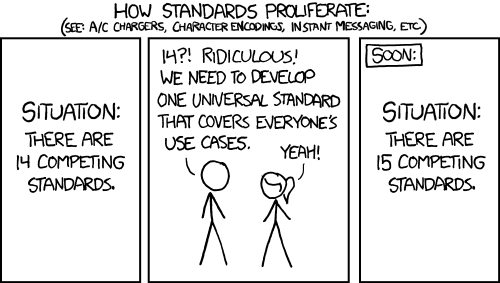
And a funny cartoon from XKCD on data standards (and the public good)


Tuesday, July 26, 2011

Information - "the single best basis for improvement"

Mario Morino's book, Leap of Reason, is the clearest articulation of how and why we should be thinking hard about data, information and learning in order to do what we do. Take 6 minutes and listen to Mario himself:


I think we're beginning to reinvent the core elements of philanthropy and the nonprofit sector. This include the kinds of organizations we will build and support to produce and distribute shared social goods. Leap of Reason is much more pragmatic then the abstract, long term reinvention that I'm watching occur. The core idea - the role of information in creating shared social goods - will persist. In fact, it may well be at the core of the institutions and networks we are just beginning to invent.