Wednesday, April 19, 2023

X, Tw*tter, and nonprofits

Today, reporters tell us that staff at X Corp. (the company now responsible for Tw*tter) are going through its database and removing - one by one - emergency services that subscribe to the platform's API - thereby cutting off these departments (fire, emergency services) from using the social media service in emergencies.

GLAAD discovered yesterday that Tw*tter had suspended its efforts to protect transgender people, deliberately removing language in its Hateful Conduct Policy that penalized misgendering and dead-naming.

The Chronicle of Philanthropy reported today that nonprofits are sticking with Twitter, despite....everything going on over there at the company and on the platform.

Hmmm. Why are Niemöller's's words ringing in my ears? You know the ones: "First they came for the..."

Thursday, April 13, 2023

Nonprofits and privacy laws

                                                                                                    Photo by Mike Scheid on Unsplash

Colorado privacy law INCLUDES nonprofits - https://thenonprofittimes.com/regulation/countdown-to-colorado-privacy-law-npos-not-exempt/ 

This is as it should be. Nonprofits gather, hold, and rarely protect an enormous amount of very sensitive data of very high value. Think about it - your donations to, volunteer time at, and service from a nonprofit says a LOT about you - much more personal information than your favorite ice cream flavor. Marketers and politicians LOVE this information. And they use it to even further segment and divide us.

Philanthropists need to step up and help nonprofits protect their data and the whole sector needs to massively improve their data governance and protection processes OR stop collecting data OR stop lobbying their way out of accountability.

Thursday, March 30, 2023

Nonprofits, campaign finance and more blows to democracy

                                                        Photo by Jason Dent on Unsplash 

I changed my job in response to the Citizens United decision by the Supreme Court of the United States (SCOTUS). I was convinced at the time (2010) that the Court's decision would lead to the transformation of many nonprofits from advocacy organizations to money laundering tools for political donors. I was right.

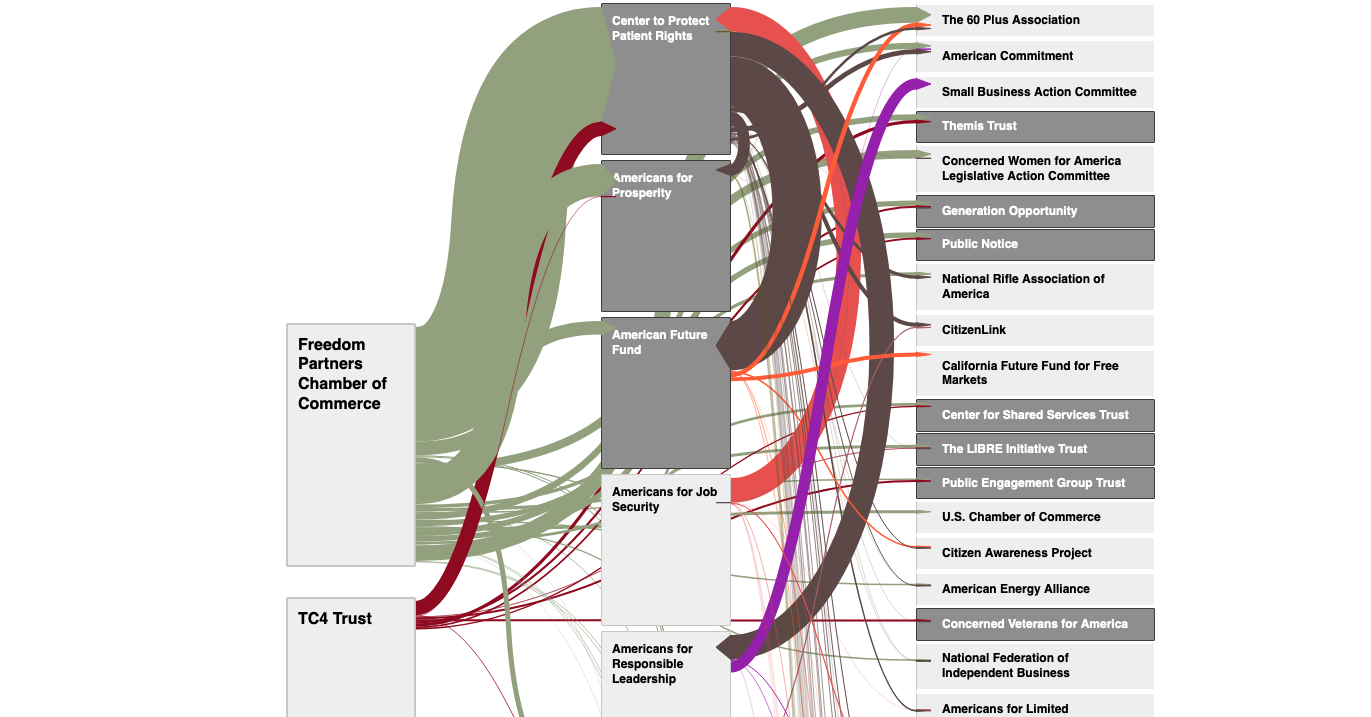
It's been hard to prove the scope of this for the very reason it's happening. Nonprofit law allows for donor anonymity; campaign finance law does not. By using nonprofits to "wash" their names from political donations, it makes it very hard to track money back to its source. The amazing web of connections that Jane Mayer drew out in her book Dark Money and ProPublica documented here shows how hard this can be. These concerns were part of what led Rob Reich, Chiara Cordelli and I to write Good Fences: The Importance of Institutional Boundaries in the New Social Economy (2013).


                                                    https://projects.propublica.org/graphics/koch

The rules on donor anonymity that come from the nonprofit sector have proven to be remarkably adaptable tools for "washing" donors' names from political contributions. This can be done by moving money from a c3 to a c4. It can be done by opening and closing a c3 or c4 in-between the required reporting periods. It can be done by creating layers of relationships between c3s and c4s and crowdfunding platforms. It can be done - and is being done - because the laws about nonprofits (and the regulators of them - state attorneys general, the Internal Revenue Service (IRS), and, in the case of Florida, the state Department of Agriculture & Consumer Services) intersect somewhat orthogonally with the laws about elections and political donations (and with the FEC and state level oversight bodies).

What's worse, is that Citizens United was only a point on a path. There are trend lines that can be spotted and forces identified working very hard to further dilute any distinctions between charitable anonymity and political anonymity. Today, in an article by Rick Hasen, an election law expert, I read that we are heading toward:

"..a world in which many of the remaining regulations of money in politics could well be struck down as unconstitutional or rendered wholly ineffective by a Supreme Court increasingly hostile to the goals of campaign finance law and extremely solicitous of religious freedom."(fn)

I can't quote more of the article - and shouldn't have quoted that much - as the article is in draft form and was discussed at a conference celebrating Professor Ellen Aprill. (Grateful to the blog post by Gene Takagi that led me to the event). You can download the draft paper here

In a nutshell, Professor Hasen uses Professor Aprill's work to show the intellectual and legal history that will likely use religious freedom to deregulate political donations. How? Via the deregulation of political activity in churches and houses of worship. There's much more to it (read the paper) but that gets us started. 

What does this mean for nonprofits? More politics. More money laundering. Less trust. 

What does it mean for democracy? More blurring of boundaries between nonprofit and commercial corporations. More anonymous money in politics. Less trust. More plutocratic control. 

It's not a positive tale. But thanks to Professors Aprill and Hasen, we've been warned. So, what are we going to do about it?


(fn)Richard L. Hasen, Nonprofit Law as the Tool to Kill What Remains of Campaign Finance Law: Reluctant Lessons from Ellen Aprill,"Forthcoming, 56 LOYOLA OF LOS ANGELES LAW REVIEW (2023) (special festschrift symposium honoring Ellen Aprill)

Wednesday, March 29, 2023

Civil society and the splitting of the US


                                                                    Photo by Viktor Talashuk on Unsplash

Civil society organizations are on the front lines of advocating for or against the most divisive issues in the United States. The following list is organized by rights. The links are almost entirely to civil society organizations fighting to protect the rights to free expression, free assembly, voting, reproduction, and work. Their civil society opponents on these issues are noted under each section.

(I'm sure there's more to add here - feel free to send additions to @mastodon.social@p2173 or comment below)

Book bans, educational censorship and attacks on free expression

Pen America reports there have been 86 state bills proposed that would censor a wide swath of educational materials and ban books, mostly on Black people, LGTBQ+ people, and discussions of critical race and queer theory (college level). An increasing number of these bills allow a single person to request removal of any number of books, and for those books to be removed before any kind of review. Thirty-two states and more than 150 school districts have implemented book bans.

        Notable nonprofits for book bans:

Moms for Liberty, formed in 2021, has 200 local chapters. It is both a c3 and a c4. Other national groups with branches include US Parents Involved in Education (50 chapters), No Left Turn in Education (25), MassResistance (16), Parents’ Rights in Education (12), Mary in the Library (9), County Citizens Defending Freedom USA (5), and Power2Parent (5).

Another 38 state, regional, or community groups advocating for book removals appear unaffiliated with the national groups or with one another.

        Notable nonprofits against: PEN America, American Library Association, many others

Protest bans and attacks on free assembly

Thirty-nine states have passed laws limiting protest. While a handful of jurisdictions have passed laws limiting the use of facial recognition by police, most places have not done so. In 2021, half of the 42 US federal agencies that are part of law enforcement owned or used facial recognition technology. Corporate use of SLAPP lawsuits against individual protestors are rising in numbers. Open carry laws for handguns exist in 36 states and you can carry a long gun openly in 44 states. Guns at protests are hard to square with the idea of peacable assembly. 

Notable organizations promoting protest bans: Police associations, Republican officials,

Notable organizations fighting against them: Civil Liberties Defense Center, ACLU, BLM

                                                    https://worldpopulationreview.com/state-rankings/open-carry-states

Voting rights

As of 2021, nineteen states had passed laws making it harder to vote. Eighteen states were carrying over 152 bills to restrict voting in 2022. 

Notable organizations promoting voting restrictions: Americans For Prosperity, Heritage Foundation, ALEC

Notable organizations fighting against restrictions: Voting Rights Alliance, ACLU, some election administration groups, Fair Fight, Brennan Center, Lawyers Committee for Civil Rights

Reproductive rights

Have split the U.S. in two - with 24 states banning access to abortion. These states are also adding vigilante bonuses and surveilling communications and travel.

Notable organizations promoting reproductive restrictions: see this list

Notable organizations fighting for access to healthcare: see this list

Right to work

These laws, whose name implies one thing but which actually focus on restricting the right for labor to organize, exist in 27 of the 50 states.

Notable organizations promoting voting restrictions: Americans For Prosperity, Heritage Foundation, ALEC, Republican Party

Notable organizations fighting against restrictions: AFL-CIO, SEIU, Center for American Progress, Democrats

Behind all of these organizations are donors. Some are heavily supported by individuals, others by foundations, others by corporations. Many rely on crowdfunding or on a mix of all of these funding structures. Behind each issue, on each side, is a mix of 501c4 and 501c3 organizations - an approach that makes it easy to hide the identities of donors whose interests are primarily political but who desire anonymity. New case law on donor anonymity in such situations, and conservative groups efforts to enable even greater anonymity for political donors, further complicates our ability to know who is funding what. 

I don't have a conclusion to offer to this post. Yet. Instead, view this as "first draft thinking" for Blueprint 2024. I welcome your feedback.